German and English wedding invitations in one link
Written by the Wedvite founders
A German and English Wedvite invitation is a single link: guests switch between DE and EN, read the whole invitation in their language and answer the RSVP there, while you see every reply in one list. It costs $49 once with unlimited guests, and the second language adds $10.
Wedvite's list price is $89. This code brings it to $49, applied automatically at checkout:

Tap to open the live invitation
What German and English guests each get
DE / EN switch for every guest
Your family in Stuttgart reads German and your friends from Dublin read English, on the same link, each with every section translated.
See it →RSVP fully in German
Questions, buttons and dietary options appear in German for German readers, glutenfrei and laktosefrei included, and in English for everyone else.
See it →One list of Zusagen
Every acceptance and refusal, from either edition, lands in one guest list with names and party size per household.
Standesamt and celebration as separate rows
Add a row for the civil ceremony and one for the party, and a second location with its own map link for the second venue.
Live updates on the sent link
If the registry office moves your slot, change the time and every guest sees it on the link they already have.
One map, one song, one set of times
Venue pins, your song and every time are entered once, so the DE and EN editions never disagree.
Real designs · open every preview
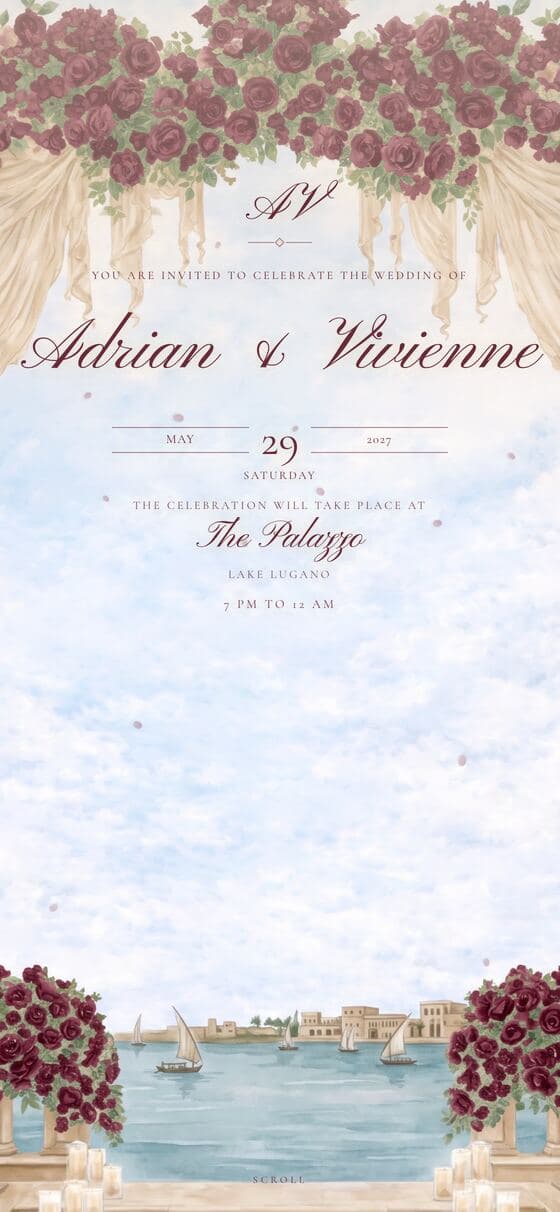
Designs German and English couples start from



How does a German and English invitation work?
Start in German and both the editor and the invitation begin in German; add English as the second language. Section headings, countdown and RSVP questions are already translated, and each line you write has a German and an English version. That lets the German edition say 'Wir freuen uns auf euch' while the English one says 'We can't wait to celebrate with you', rather than one awkward compromise.
Guests open the invitation in your first language and switch with DE / EN. For an expat couple in Berlin or Munich, that means the German relatives and the international friends get one link, in one WhatsApp or email, and nobody is left reading a machine translation of a card that was never written for them. The RSVP, the map and the countdown come along in both editions.
What does the English or German edition cost?
The invitation is $89, paid once: first language, unlimited guests, RSVP and the envelope are included. The second language is $10, so German and English together come to $89 plus $10. Nothing scales with the guest list, so a short list and a long one cost the same. The design, the envelope, the RSVP and the map are part of that one price; music, a wax seal and a venue sketch are optional extras priced separately.
You can build both editions free of charge and share the free invitation with your first 10 guests, enough to have a German speaker and an English speaker proofread their editions. A German reader will catch a du-and-Sie slip that no translation tool flags. The editor shows the language add-on in your currency before checkout, and the invitation stays online through your wedding date and at least 90 days after.
How does German wedding wording differ from English?
The first decision in German is Sie or du. A formal invitation from the parents uses Sie ('laden Sie herzlich ein'); most couples today write to friends and family with du or ihr, which would read as over-familiar in a formal English card yet perfectly normal in German. English has no such choice, so its tone comes from the opening instead: 'request the pleasure of your company' against 'invite you to celebrate'.
German invitations also announce the occasion directly ('Wir heiraten!') and often ask guests to reply with u.A.w.g., um Antwort wird gebeten, by a date. They regularly cover two events, the Standesamt and a church or free ceremony, sometimes on different days. Name each event clearly in both editions so English guests know which one they are invited to, and keep the reply date identical in both.
- ✦German, formal: „Anna Weber und Thomas Clarke freuen sich, Sie zu ihrer Hochzeit einzuladen“
- ✦English, formal: “Anna Weber and Thomas Clarke request the pleasure of your company at their wedding”
- ✦German, relaxed: „Wir heiraten! Feiert mit uns, u.A.w.g. bis zum 1. Mai“
- ✦English, relaxed: “We're getting married, and we'd love you there. Kindly reply by 1 May”
How do you show a civil and a church ceremony in two languages?
Schedule rows carry a time and a title, not a date, so put the day in the title when the events are on different days: 'Fr · Standesamt · Civil ceremony'. Those row titles are shared by the German and English editions, which is why writing both languages in one row works well. Add the second venue as its own location with a map link, so guests can navigate to the registry office and the party.
One link shows the same program to everyone. If only close family attend the Standesamt, say so in the row ('family only · nur Familie') rather than expecting the invitation to hide it from some guests; there is no per-guest version of the schedule. A short line explaining who each event is for saves awkward questions later, and the times and map links stay identical in both languages.
The questions everyone asks.
Can guests pick their language?+
Do both families RSVP on one list?+
Can I add a third language?+
Can the editor be in German?+
How much does a German and English invitation cost?+
Can I show the Standesamt and the celebration on different days?+
One link. Every guest.
Design it free, share it with your first 10 guests, then pay $49 once for unlimited guests — RSVP, envelope and WhatsApp delivery included.
Start your invitation