Best wedding websites UK, compared for 2026
Written by the Wedvite foundersPrices checked 15 September 2026
The free pick is The Knot: the website, RSVP tracking and guest messaging cost nothing, with no paid tier above them. The design pick is Riley & Grey, free to build and paid to publish. For one link that opens as an animated invitation and carries the venue, the schedule and the RSVP, Wedvite is £89 flat, unlimited guests.
This code takes 45% off at checkout, applied automatically:
Ten builders, checked against their own pricing and help pages on 15 September 2026. Competitor figures are US list prices in US dollars; ours are in pounds.
Which wedding website builder is best for a UK wedding?
All ten do RSVP, so the columns that separate them are the price, what the free tier really covers, whether the builder can reach a phone, the address your guests see, and whether a digital invitation is part of the product at all.
| Builder | Price (US list, USD) | Free tier | RSVP | WhatsApp or text | Custom domain | Digital invitations included |
|---|---|---|---|---|---|---|
| Wedvite | £89 flat, paid once, unlimited guests, no per-guest fee (in pounds) | Partly — design everything free and share with your first 10 guests; pay once to publish for everyone | Yes — on the invitation itself, with meal and dietary answers | Yes — you paste the link into WhatsApp or a text from your own number | No — invitations live on a wedvite.net link | Yes — the invitation is the product |
| The Knot | Free website; custom domain $19.99/yr | Yes — all core website features, no tier and no trial | Yes | Partly — a link you share yourself by text, email or QR code | Yes — $19.99/yr, or $99.99 for .wedding | No — free digital save the dates only |
| Joy | $0/mo core; custom domain around $19.99 per year | Yes — website, RSVP and Basic cards | Yes | Partly — email free; Joy's own SMS is a paid add-on for US and Canadian numbers | Partly — around $19.99 per year, forwarding only | Yes — free Basic cards; Premium cards paid |
| Zola | Free website; custom domain from $17.99/yr | Yes — website and digital save the dates | Yes | Partly — a link you copy and share by text, email or DM | Partly — from $17.99/yr, forwarding only | No — free digital save the dates only |
| Minted | Free website + Free online invitations; custom URL $15/yr | Yes — website and online invitations | Yes | Partly — email or a copyable link only | Yes — custom URL $15/yr | Yes — free Online Invitations |
| Squarespace | Basic $25.00/mo or $228.00/yr; no free plan | No — 14-day trial only; no free plan | Yes — a generic form block, no RSVP dashboard | Partly — no send channel; Email Campaigns is a separate subscription | Yes — included, free for year one on annual plans | Partly — the site plays the invitation role |
| Wix | $0 with a Wix ad; Light $17/mo (yearly) | Yes — a wixsite.com address with a Wix banner ad | Yes — the Wix Events RSVP form | Yes — email campaigns, or email and SMS from the Wix owner app, with no country limit stated either way; WhatsApp only by exporting an image and sending it yourself | Partly — paid plan only; the free plan is a wixsite.com address | Yes — sent as email campaigns |
| Bliss & Bone | Website $15/month or $21/month; invitations $0.90 per recipient | Partly — design and preview free; sending and the website are paid | Yes | Yes — email and a WhatsApp link worldwide, with platform SMS in North America only | Yes — offered with the website plan; no price published | Partly — $0.90 per recipient |
| Riley & Grey | $39/mo or $299/yr to publish | Yes — free to build; pay to publish | Yes — live RSVP needs a published (paid) site | Partly — every send is email | Yes — included with membership | Yes — unlimited sends with membership |
| RSVPify | $0 to 100 guests; Gold $10/month | Yes — one event, up to 100 guests, email invitations | Yes | No — email only; no built-in text or WhatsApp sending | Partly — a redirect at $99 one-time, from a 2023 help article | Yes — email invitations on every tier |
Is Wedvite a wedding website or a digital invitation?
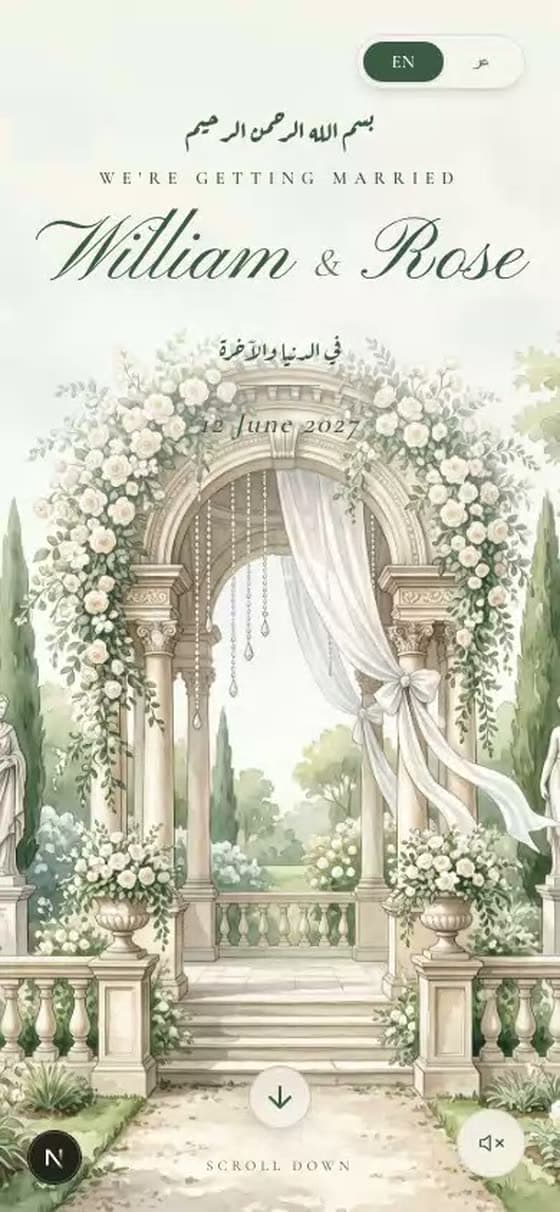
Both, in one link, which is the whole proposition. Guests open an animated envelope, hear the design's music, tap the venue map and reply on the same page; meal choices and dietary answers come with the RSVP, and you get a live headcount and a CSV export for the venue. You send the link from your own WhatsApp or by text, guests need no account, and you can correct a time after sending.
It is £89 flat, paid once, for unlimited guests. Designing is free, and so is sharing with your first 10 guests. There are more than 30 designs in 11 languages, hosted through your wedding date and at least 90 days after. A hero-only save the date is £19; your own music, a wax seal, a venue sketch and a second language are optional extras, each priced on its own.
Where it loses: no custom domain, no planning suite, no registry, and we cannot message your guests for you. The UK product page is digital wedding invitations UK, and pricing lists every line.


Is The Knot's wedding website free?
Yes, fully, and that is why it is the free pick. The Knot's help centre states that the free website includes every core feature with no paid upgrade, subscription or trial: the guest list, RSVP tracking and the Messaging Hub are all in. For a couple who wants a wedding website and nothing more, there is no better value on this page.
Two things a UK reader should know. The only flat add-on is a domain, $19.99 a year for a standard extension (it does not auto-renew) or $99.99 for .wedding. And The Knot sells no digital wedding invitation: the free digital product is a save the date, and invitations are printed paper sold per card, priced in dollars.
Pick it for a complete free website with a real guest list. Prices from The Knot's help centre.
Is Joy's wedding website free?
Yes, and Joy's free tier is the widest here: $0 a month buys the website, a planning dashboard, a registry, the mobile app, unlimited guests, online RSVP and Basic digital cards you can email or share by link with no minimum order. Joy earns on registry purchases and printed cards instead.
The UK caveat is the one to read twice: Joy-originated SMS is a paid add-on restricted to US and Canadian numbers, so for a British guest list the delivery route is email or a link you paste yourself. The envelope and reveal animation are Premium-only at a price Joy does not publish, and the custom domain (about $19.99 a year) forwards only, so withjoy.com stays in the browser bar.
Pick Joy for the most complete free package. Prices from Joy's pricing page.
Is Zola's wedding website free?
Yes. The website is free for unlimited guests, RSVP is built in, and digital save the dates are free to share by link. The one digital extra Zola puts a price on is a custom domain, from $17.99 a year and auto-renewing, which forwards to your zola.com address rather than replacing it; Premium website effects and Premium guest messaging are paid at prices Zola does not publish.
The fact that decides it for most readers: Zola does not sell a digital wedding invitation at all. Its invitations catalogue is printed paper, from $1.79 a card in dollars, so going that route means a paper plan with its own print run and postage to price separately, or a digital invitation from somewhere else.
Pick Zola for a free site with a registry. Skip it if the invitation itself should be digital. Prices from Zola's website page.
Is the Minted wedding website free?
Yes, and unusually Minted gives away both halves: a free wedding website with event RSVPs, a registry, maps and accommodation pages, and free Online Invitations with RSVP collection and custom RSVP questions. Nothing Minted publishes charges per guest.
The upsells are flat — a custom URL at $15 a year, an original-artwork website from $270 — and the limits are in the sending and the opening: delivery is email or a copyable link with no SMS or WhatsApp channel of its own, and the invitation is a static page with no envelope or reveal.
Pick Minted if you want a free website and a free invitation that match. Prices from Minted's help centre.
Can you use Squarespace for a wedding website?
You can, and plenty of British couples do, but know what you are buying: a general website builder with wedding templates rather than a wedding product. There is no free plan, only a 14-day trial, and the cheapest plan is Basic at $25.00 a month or $228.00 a year. A custom domain is included on every plan, free for the first year on annual billing — the best domain story on this page.
RSVP is where it falls down. It is a generic form block: replies go to an email address, a spreadsheet or Mailchimp, with no RSVP dashboard, no meal tally and no reminder. There is no invitation product either — the site plays that role — and emailing guests is a separate Email Campaigns subscription at a price Squarespace does not publish on that page.
Pick Squarespace if design control and a real domain matter more than wedding tooling. Prices from Squarespace's pricing page.
Can you make a wedding website on Wix?
Yes, and for nothing: a Wix site publishes free on a wixsite.com address with a Wix banner ad. The Light plan at $17 a month (paid yearly) removes the ad and includes a domain for the first year.
Wix is general-purpose, but its Events RSVP is pitched at weddings — a registration form, a guest limit, a waitlist, meal preferences and extra guests — and it is one of the few builders here that can reach a phone itself: invitations go out as Wix Email Marketing campaigns (200 emails per month included) or by email and SMS from the owner app. There is no envelope and no reveal.
Pick Wix for a free site with a working RSVP form if you can live with the ad. Prices from Wix's plans page.
How much does Bliss & Bone cost?
Two bills. The website is a subscription, $15/month Standard or $21/month Premium after a free trial, and online invitations are charged per recipient on a volume ladder ($0.90 each from ten recipients), with design and preview free until you send. Neither includes the other.
It earns its place here on delivery and on guest groups: email and a WhatsApp link work worldwide, which most of this table cannot say, and the Premium website plan adds private events — the closest thing on this page to a proper day-guest and evening-guest split. Platform SMS is North America only, the card is a single flat page with no envelope, and a monthly bill runs for as long as your engagement does.
Pick Bliss & Bone for a designer website and invitation from one studio. Prices from Bliss & Bone's invitation page.
How much does Riley & Grey cost?
Building is free with no trial clock; publishing costs $39 a month or $299 for a twelve-month package. Digital invitations and save the dates come with the membership and are uncapped, so the price does not move with the guest list, and a custom domain is included.
The RSVP is the most thorough here — meal preferences, travel details, song requests, per-event guest gating and a tracker showing who has opened the invitation — and the per-event gating is the feature to look at if your day and evening lists differ. Live RSVP needs a published, paid site, and the invitations themselves are plain: the help centre describes an email-shaped card with no animation.
Pick Riley & Grey for the best-looking site on this page. Prices from Riley & Grey's pricing page.
Is RSVPify free for a wedding?
For an ordinary British guest list, yes: the Personal Events free tier is $0 for one event and up to 100 guests with 100 email credits, which covers a great many weddings outright. A 101st guest moves you to Gold at $10 a month, and Platinum covers 500.
It is an RSVP tool first and a website second, and two things follow. Delivery is email only — its help centre says there is no built-in text or WhatsApp sending, the one clean “no” in that column — and third-party ads and offers appear on confirmation screens unless you pay to remove them, which is the one place on this page where your guests see somebody else's advertising. A custom-domain redirect is documented at $99 one-time in a 2023 help article the current pricing pages do not repeat.
Pick RSVPify if the guest list is the job and the invitation is not. Prices from RSVPify's pricing page.
Do these builders charge in pounds?
Not one of them published a GBP price on 15 September 2026. Every figure in the table is a US list price in US dollars, which matters in two ways a feature list will not show you. A one-off charge — $19.99 for a domain, $15 for a custom URL — becomes the converted amount plus whatever your card issuer adds for a non-sterling transaction. A subscription converts again every month, so a $15/month website or a $39 membership is a small moving bill for the length of your engagement rather than a number you can put in the budget.
We have not converted them for you on purpose. A converted figure is our arithmetic on a date we chose, presented as somebody else's price; when you open their page you will see the dollar number, and the two should agree. Wedvite is the exception in this table because it is our own price: £89 is charged in pounds, once, for unlimited guests.
Which builders can send the invitation to a phone?
Wix and Bliss & Bone can get the invitation onto a phone, and the route matters more than the grade: Wix (email campaigns, or email and SMS from the Wix owner app, with no country limit stated either way; WhatsApp only by exporting an image and sending it yourself); Bliss & Bone (email and a WhatsApp link worldwide, with platform SMS in North America only). The Knot, Joy, Zola, Minted, Squarespace and Riley & Grey are graded partly: they can email, or they give you a link to share yourself, but WhatsApp and text are not channels they operate. RSVPify sends by email only. Wedvite is the paste-it-yourself kind too, on purpose: the invitation goes out from your own number, so it arrives as a message from you.
This is the column that most separates a UK shortlist from a US one. British guests are reachable on WhatsApp — the family thread, the group organising the hen do — and a link pasted into a chat by one of the couple is opened in minutes. A builder-operated SMS gateway that only holds US and Canadian numbers is, for this guest list, no send channel at all; email is fine for parents' friends and slow for everybody under forty.
So read the column as two different questions. “Can it reach a phone?” matters if you want reminders to go out in bulk from the product. “Does the link work when I paste it?” is true everywhere, and for most couples that is the actual workflow. How we handle it is in wedding invitations by WhatsApp, and the printable route is a QR code on a card.
How do you handle day guests and evening guests?
This is the question no US round-up answers, because the convention is British. Day guests come to the ceremony and the wedding breakfast and stay for the evening; evening guests arrive after the meal for the drinks, the cake and the dancing. A church and a sit-down meal have a capacity; a dance floor does not.
Two builders here have a feature for it. Riley & Grey documents per-event guest gating, so a named guest sees only the events they are invited to, and Bliss & Bone's Premium website plan adds private events. Everywhere else — including on our own product — the convention is handled by wording rather than by access control, and honestly that is enough for most weddings: one page listing the ceremony, the wedding breakfast and the evening, and an evening invitation that opens on the evening.
The wording is where it is won or lost. Send both invitations at the same time so nobody hears about the wedding from somebody else first. Use the same design for both, so the evening invitation is never the cheap version. Give an arrival time and an end time, because an evening guest is planning an arrival rather than a whole day. Never explain the split and never apologise for it. Two complete examples, a day invitation and its evening pair, are in our wedding invitation wording guide, and the UK product page is digital wedding invitations UK.
Do you need a wedding website as well as an invitation?
Often not. A wedding website exists to answer what a card cannot: where the venue is, when things start, what to wear, how to reply. If the invitation link already carries the date, the map, the schedule, the dress code and the RSVP, most guests never need a second address, and one link is easier to send and to keep correct than two.
You do want a separate website when the wedding runs over several days with travel and hotel blocks, when there is a registry and a large gallery to host, when different guest groups need pages of their own, or when you want your own domain. That is exactly what the free builders above are good at. Our side of it is on the wedding website page, what to include on a wedding website lists the content, and wedding website examples shows real ones on a phone.
Comparing the same builders on RSVP rather than on the UK market is best wedding websites with RSVP; the free question on its own is free wedding websites.
How we compared
On 15 September 2026we opened each builder's own pricing or help pages and wrote down the published price, what the free tier includes, how RSVP works, what the builder itself can send and to where, whether a custom domain is offered and at what price, and whether a digital invitation is part of the product. Where a page did not state something we wrote “not verified” rather than estimating it. The pages we read are linked under the table and in each verdict.
Four UK-facing builders are named under the table and are not in it — GettingMarried, Bridebook, My Wedding Site and Ode — because nothing about them was checked that day, and an unchecked row in a dated table is worse than no row. That is the honest state of this page rather than a judgement on them.
Wedvite wrote this page and is one of the ten. Read the row: no custom domain, a free tier that stops at 10 guests, no registry, no planning suite, and no way for us to message your guests. Where a free builder is the better answer we have said so. Every head-to-head we have written is on the compare hub.
The questions everyone asks.
What is the best wedding website for UK couples?+
Are wedding websites free in the UK?+
Do these wedding website builders charge in pounds?+
Can a wedding website handle day guests and evening guests separately?+
Can UK guests RSVP without creating an account?+
Can I use a .co.uk domain for our wedding website?+
One link. Ceremony, reception, evening, RSVP.
Pick a design, type your names and watch it open in 60 seconds. £89 once, unlimited guests; free to design and share with your first 10.
Start your invitation