Spanish and English wedding invitations both families can read
Written by the Wedvite founders
One Wedvite invitation carries Spanish and English on a single link. Guests tap ES or EN to switch, the RSVP form asks its questions in the language they are reading, and replies from both families land in one guest list. The invitation is $49 once for unlimited guests; the second language adds $10.
Wedvite's list price is $89. This code brings it to $49, applied automatically at checkout:
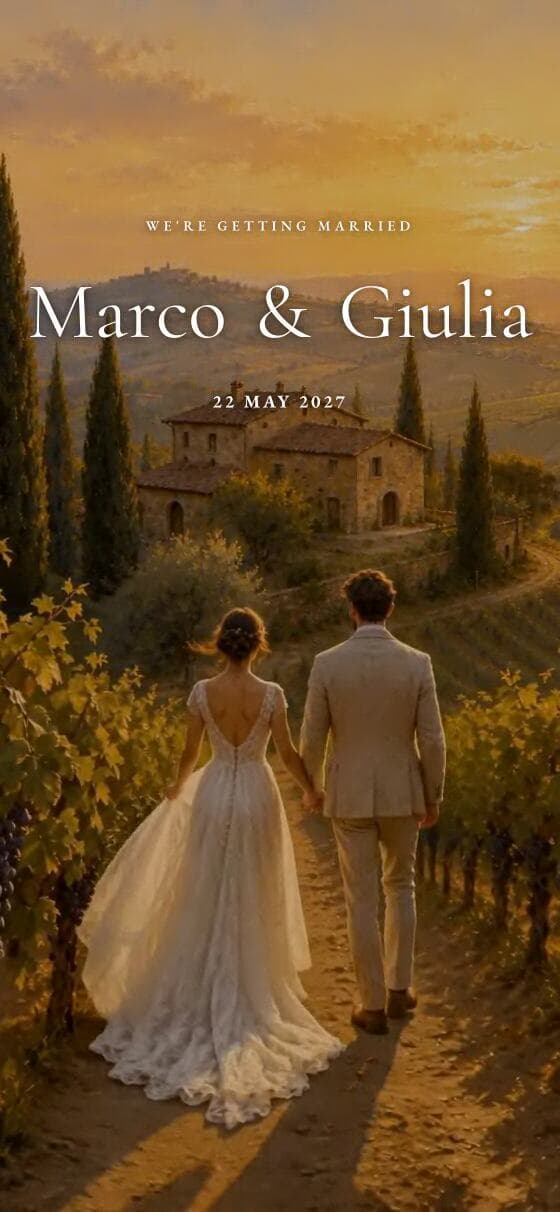
Tap to open the live invitation
What both sides of the family get from one link
A language switch on the invitation
Guests tap ES or EN on the invitation itself, so a grandmother in Guadalajara and a roommate in Chicago open the same link and each reads a complete edition.
See it →The RSVP form in Spanish too
Attendance, each guest's name and dietary needs are asked in the language the guest is reading, and the dietary options themselves (sin gluten, vegano) are translated as well.
See it →One guest list for both families
A reply sent from the Spanish edition and one sent from the English edition arrive in the same list, so the headcount is one number, not two spreadsheets.
Changes go live on the same link
Move the dinner time after sending and everyone sees the new time on the link they already have. Nobody needs a second message or a corrected card.
One map, one song, one set of times
The venue pin, the song you add and every time in the schedule are entered once, so the two editions can never disagree about when or where.
Real designs · open every preview
Designs Spanish and English couples start from



How does one invitation work in Spanish and English?
You build the invitation once and switch on the second language in the editor. The built-in lines, such as the section headings, the countdown and the RSVP questions, already exist in Spanish and English, so the second edition starts complete rather than blank. Lines you write yourself, like the welcome message or a dress-code note, keep a separate Spanish and English version: switch the editor to a language and type that edition's words.
Guests read one language at a time. The invitation opens in the language you choose as the first, and the ES / EN switch changes it with a tap. On a phone that is the difference between a readable card and a cramped one: printing both languages line by line halves the type, while two full editions keep each one comfortable. Names, date, photos and map are identical in both.
How is the second language priced?
The invitation is $89, paid once, and that price already includes your first language, unlimited guests, the RSVP form and the animated envelope. Adding the second language costs $10, so a Spanish and English invitation is $89 plus $10. Nothing is charged per guest, per reply or per send, so a list that doubles after you publish costs the same.
You can build both editions before paying anything. Designing is free, and the free invitation can be shared with your first 10 guests, which is enough to check that your tía and your best man both read it comfortably. The language add-on is shown in the editor in your own currency before checkout, and the invitation stays online through your wedding date and at least 90 days after.
How does Spanish wedding wording differ from English?
A traditional Spanish invitation opens with both sets of parents, each named with two surnames, who 'participan el enlace' of their children; the couple comes after them. English invitations lead with the hosts in one line or, more often now, with the couple themselves. Spanish formal copy addresses the guest as usted ('tienen el gusto de invitarle'), while a relaxed invitation moves to 'te invitamos', which reads warmly in Mexico and in Spain.
Write each edition in its own natural order instead of translating line by line. 'Request the honor of your presence' sounds stiff when forced into Spanish, and 'participan el enlace' has no natural English twin. Keep the facts identical and let each edition sound like someone from that side of the family wrote it. Spanish even has its own RSVP: S.R.C., se ruega contestación.
- ✦Spanish, formal: «Antonio García Ruiz y Carmen López Vidal participan el enlace de su hija Lucía con James Carter»
- ✦English, formal: “Mr. and Mrs. Antonio García request the honor of your presence at the marriage of their daughter Lucía to James Carter”
- ✦Spanish, relaxed: «Lucía y James, junto a sus familias, te invitan a celebrar su boda»
- ✦English, relaxed: “Together with their families, Lucía and James invite you to celebrate their wedding”
What is shared between the Spanish and English editions?
Some things are set once on purpose: the date, the times, the venue pin, the photos and the song. That way a Spanish reader and an English reader can never be given different start times. Schedule rows and extra locations go one step further and keep a single text that both editions show, so write those rows in both languages, for example 'Ceremonia · Ceremony', and the whole family reads the same running order.
Sending is equally simple. The invitation is one link, so you paste it into the family WhatsApp group in Mexico or Spain and into iMessage for friends in the US from the same share sheet. Each guest picks their language when it opens; you never maintain two versions or two send lists. Guests need no app or account to open it; it works in the browser on any phone.
The questions everyone asks.
Can guests pick their language?+
Do both families RSVP on one list?+
Can I add a third language?+
How much does a Spanish and English invitation cost?+
Can I use the editor in Spanish?+
Should the Spanish or the English version open first?+
One link. Every guest.
Design it free, share it with your first 10 guests, then pay $49 once for unlimited guests — RSVP, envelope and WhatsApp delivery included.
Start your invitation