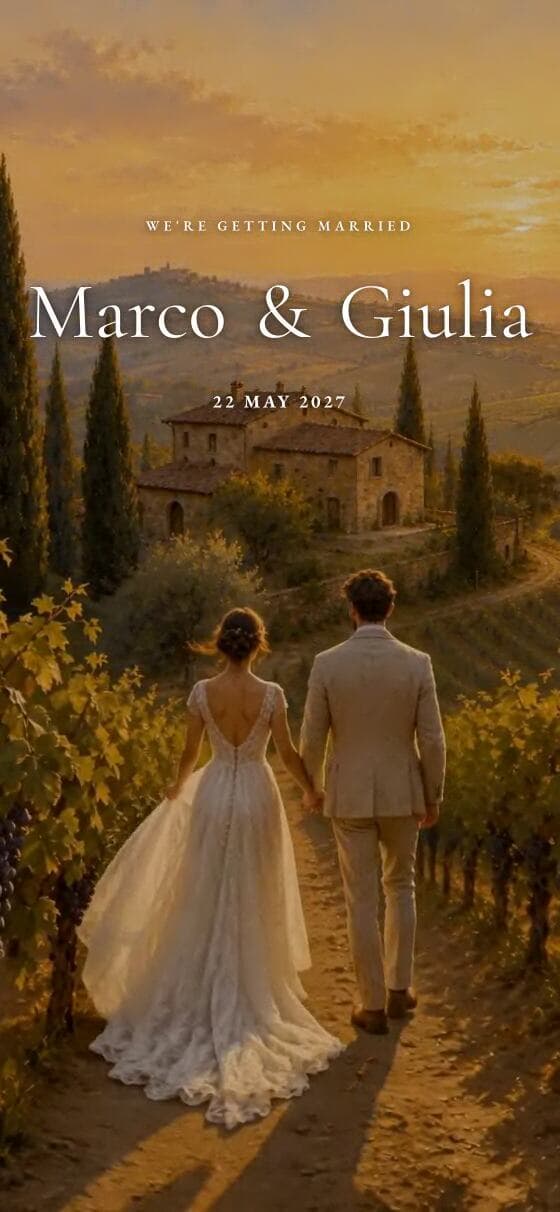
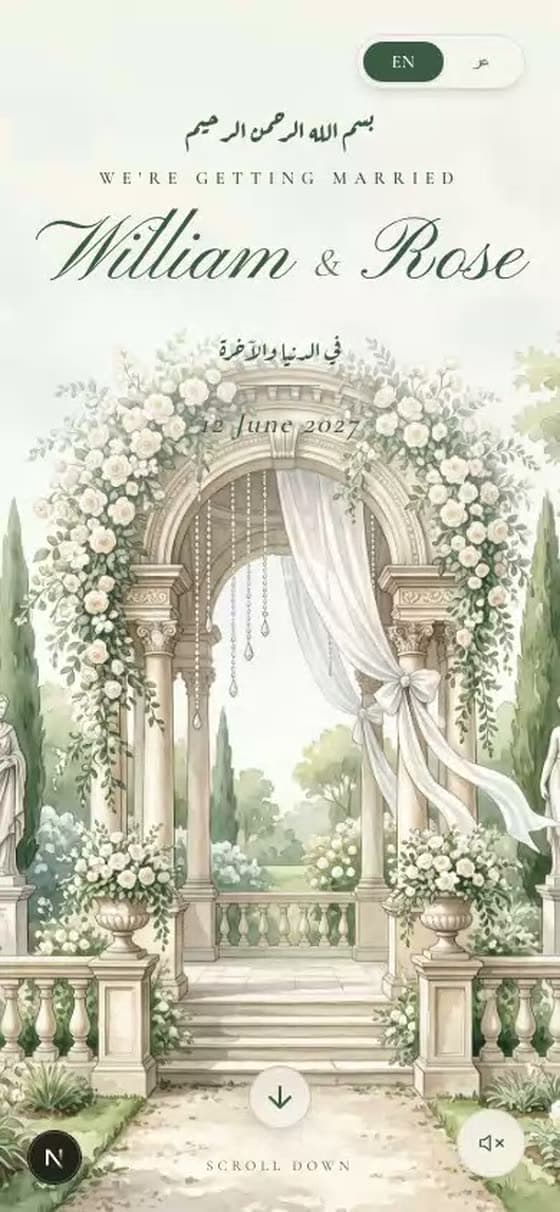
British guest lists usually split in two, and no other market does this in quite the same way. Day guests come to the ceremony and the wedding breakfast — the name for the meal afterwards, whatever time it is served — and stay for the evening. Evening guests arrive after the meal, for the drinks, the cake and the dancing. It is a practical convention rather than a slight: a church and a sit-down meal have a capacity, a dance floor does not.
Three rules make it land well, and they are the same rules on a link as on a card. Send both invitations at the same time, so nobody hears about the wedding from somebody else first. Use the same design for both, so the evening invitation never looks like the cheap version. And never explain the split on the invitation itself — no “due to limited numbers”, no apology. An evening invitation is an invitation to a party, and it should read like one.
The wording changes in two places. The evening version invites the guest to the evening celebration of your marriage rather than to the ceremony, and it gives an arrival time andan end time — “7:30pm until midnight”, or “carriages at midnight” if you want the traditional phrasing — because an evening guest is planning an arrival, not a whole day. Keep the reply deadline on both: the caterer still counts evening food. Two complete examples, a day invitation and its evening pair, are set out in our wedding invitation wording guide.
What the digital version adds is that the times live inside the invitation rather than on a card in a drawer. If the band starts later than planned, the evening guests' schedule is correct by the time they look at it again, and the reply line becomes one instruction — reply on the invitation by a named date — instead of a reply card and a second stamp.